
On this page
Radon gets into a house from the soil underneath it. Most homes have slightly lower air pressure inside than in the ground below, so the house pulls soil gas in through cracks, slab joints, sump pits, pipe gaps and bare crawl space soil. Once inside, radon collects, especially on the lowest floors. Local radon test data by York ZIP code shows how often that happens here.
The house acts like a vacuum
Radon forms in soil and rock and moves through the ground. Outdoors, it escapes into open air. Under a house, it meets the foundation.
Here is the key idea: your house is usually at slightly lower air pressure than the soil around it. That pressure difference pulls soil gas, and the radon in it, into the home. Several everyday things cause it:
- The stack effect. Warm air rises and leaks out of the upper floors and attic. Replacement air gets drawn in at the bottom, including from the soil. This is strongest in winter.
- Exhaust fans. Bathroom fans, range hoods and clothes dryers push air out, which pulls air in somewhere else.
- Furnaces and water heaters. Fuel-burning appliances use indoor air and vent it outside.
- Wind. Wind blowing across a house can lower pressure on one side.
The pull is small, but it runs all day, every day.
Common radon entry points
EPA lists the main ways radon gets in, and they match what we see in York homes:
- Cracks in concrete floors and walls. Concrete cracks as it cures and as the house settles.
- Floor-to-wall joints. The seam where the basement slab meets the foundation wall is one of the biggest entry paths.
- Sump pits. An open sump connects straight to the soil and drain tile under the floor.
- Floor drains. Some drain directly to soil or gravel.
- Gaps around pipes, wires and service lines. Wherever something passes through the foundation.
- Hollow block walls. Concrete block has hollow cores that can carry soil gas up and release it at the top of the wall.
- Bare soil in crawl spaces. An open dirt floor lets radon flow freely into the space and up into the house.
- Stone foundations. Older fieldstone walls have many mortar joints and gaps.
- Well water. A smaller source for most homes, but radon in well water is released when you use water.
Why the lowest floor reads highest
Radon comes in at the bottom, so levels are usually highest in basements and on the lowest floor. PA DEP test data for York County shows this clearly. Basement tests averaged about twice as high as first-floor tests.
That does not mean upper floors are always fine. Radon moves through the house with normal air flow, and some homes have high levels on every floor.
Why sealing cracks alone isn't enough
Sealing cracks sounds like a simple fix. But EPA does not recommend sealing alone, because it has not been shown to lower radon significantly or consistently. Houses keep settling and new gaps keep forming. Some entry points, like the floor-to-wall joint under finished walls, are hard to reach.
Sealing is useful as part of a full system. It helps the system work more efficiently.
How a mitigation system stops it
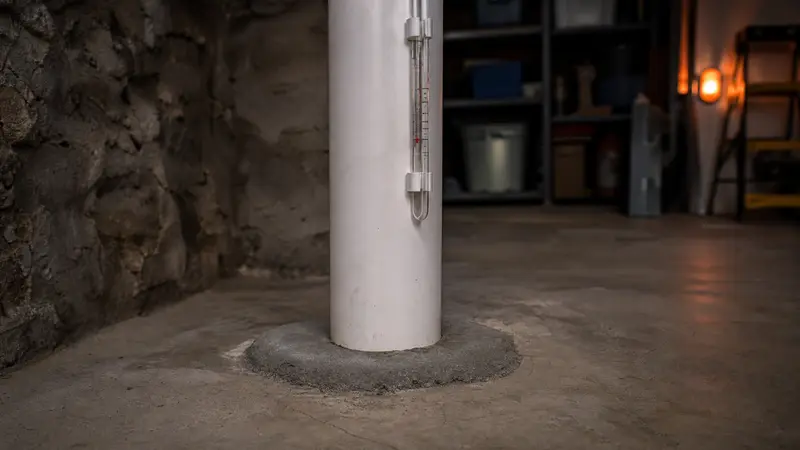
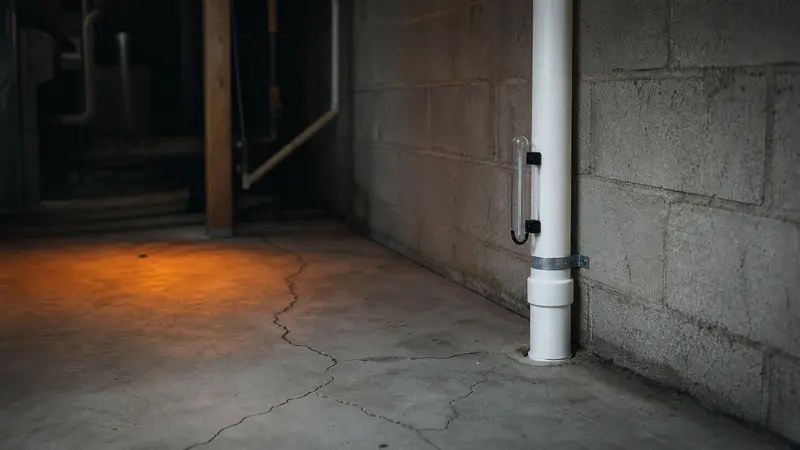
The most common fix reverses the pressure problem. A sub-slab depressurization system uses a fan and a pipe to create lower pressure under the floor than inside the house. Instead of radon being pulled into the home, it is pulled into the pipe and vented safely above the roof.
EPA calls active sub-slab suction the most common and usually the most reliable radon reduction method (EPA radon information). Crawl space homes use a sealed plastic membrane over the soil with suction underneath it.
How this plays out in York homes
York has a wide mix of housing. You'll find older homes with fieldstone or block basements, newer homes on poured concrete, plus slabs, crawl spaces and additions that combine more than one foundation type. Each has its own entry points.
Because York County is in EPA Radon Zone 1, there is plenty of radon in the ground to be pulled in. That is why EPA and PA DEP recommend testing every home.
Radon matters because of its long-term health effect. Learn more about radon health risks and symptoms.
Key takeaways
- Radon comes from the soil under the house.
- Homes pull it in because indoor air pressure is usually a bit lower than soil gas pressure.
- Main entry points are cracks, slab joints, sump pits, pipe gaps, block walls and crawl space soil.
- Sealing alone doesn't reliably fix radon.
- Sub-slab depressurization reverses the pull and vents radon above the roof.
Frequently Asked Questions
Can radon get in through a poured concrete basement with no cracks?
Yes. Concrete is not airtight, and every slab has joints and penetrations. Even a basement that looks perfect can let radon in.
Does a sump pit cover help?
A sealed, airtight sump lid helps and is a standard part of most systems. On its own, it usually won't bring a high level below 4.0 pCi/L.
Why are my results higher in winter?
The stack effect is strongest when it's cold outside and warm inside, and homes are closed up. That increases the pull on soil gas.
See how common radon is near you
Our York County radon levels page shows PA DEP test data by ZIP code. If you'd like to test or stop radon at the source, call (717) 356-3035 any time for a same-day callback.