
On this page
If your radon fan is not working, check power first: the breaker, the outlet near the fan, and any GFCI that may have tripped. Then look for ice or debris at the exhaust and read the manometer. If the fan has power but stays silent, or the gauge stays level, the fan has most likely failed, and fixing a failed radon fan means replacing it.
How to tell your radon fan has stopped
You may not notice a dead radon fan right away. These are the usual clues:
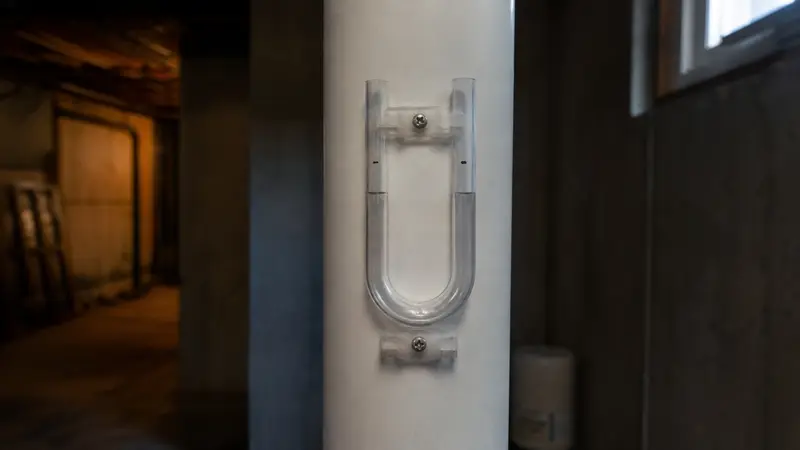
- The manometer is level. In a U-tube gauge, both sides of the liquid sit at the same height when there is no suction.
- The alarm is sounding or its indicator light has changed.
- No hum or vibration at the fan, and no airflow at the exhaust.
- A radon test came back high after being low for years.
Any one of these is reason to start troubleshooting today. While the fan is off, radon can build back up.
Step 1: Check the power
Most "dead" fans turn out to be power problems. Start here.
- Find the circuit breaker. Systems installed to current standards have the breaker labeled "Radon System." Reset it if it has tripped.
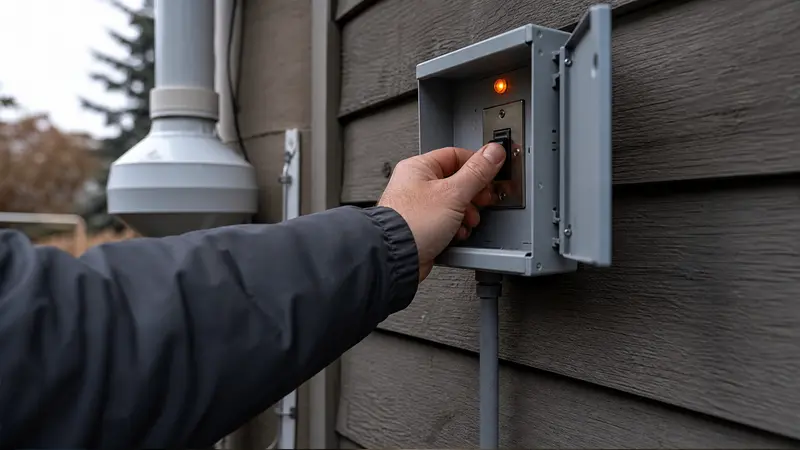
- Check the outlet. Attic and exterior fans often plug into a nearby outlet or a weatherproof box. If it is a GFCI outlet, press reset.
- Look for a switch. Fans should not be on a wall switch. If someone added one, make sure it is on.
- Check the cord for damage from pests or weather.
If you reset a breaker or GFCI and it trips again, stop. That can mean a wiring or motor fault, and it needs a professional.
Step 2: Check for blockages
A fan can run but move no air if something blocks it.
- Ice at the exhaust. On cold York mornings, ice can form at the top of the pipe or inside an exterior fan. It often clears on its own as the day warms.
- Nests or debris. Birds, wasps and leaves sometimes find their way into an open exhaust.
- Water trapped in a low spot. A sagging pipe can fill with condensation and choke airflow. You may hear gurgling.
Look from the ground with binoculars if the exhaust is high. Do not climb onto a roof to clear it yourself.
Step 3: Read the manometer
The manometer is the U-tube gauge, usually on the pipe in your basement. Your installer should have marked the normal reading when the system was set up.
- Level liquid: no suction. Fan is off or the pipe is fully blocked.
- Lower than the mark: weak suction. The fan may be wearing out, or there is a partial blockage or leak.
- At the mark: the fan is doing its job.
- Higher than the mark: can mean a blockage below the gauge, such as water at the suction point.
Small changes with the seasons are normal. Big drops are not.
Step 4: Listen and feel
Stand near the fan, in the attic or outside.
- Silent with power: motor or capacitor failure. The fan needs replacing.
- Hums but does not spin: often a seized bearing or failed start part.
- Grinding or squealing: worn bearings. The fan is on its way out.
- Starts, then stops after a while: the motor may be overheating and tripping its thermal protection.
Do not open the fan housing. It is electrical, and the pipe carries soil gas.
Step 5: Check the alarm
If the alarm is sounding but the manometer shows normal suction and the fan is running, the alarm itself may be faulty. Pressure alarms can drift or fail over time. If the alarm and the gauge both say suction is gone, trust them. Our guide on a radon system alarm going off explains what each alarm signal means.
Common causes and fixes
| Symptom | Likely cause | Fix |
|---|---|---|
| Silent, no power | Tripped breaker or GFCI | Reset; call if it trips again |
| Silent, power present | Failed motor | Replace fan |
| Hums, no airflow | Seized bearing | Replace fan |
| Runs, gauge level | Blocked or cracked pipe, ice | Clear blockage or repair pipe |
| Runs, gauge low | Worn fan, partial blockage, leak | Inspect pipe; replace fan if worn |
| Stops and starts | Overheating | Check location and load; often replace fan |
When to call a professional
Call a certified mitigator if:
- Power is fine and the fan still won't run.
- The breaker or GFCI keeps tripping.
- The exhaust is blocked and you can't reach it safely.
- The gauge stays level or low after ice melts.
- A new radon test is above 4.0 pCi/L.
In Pennsylvania, anyone who mitigates radon in a home they do not own or live in must be certified by PA DEP. You can learn more from the PA DEP Radon Division.
After the fix: retest
Once the fan is running again, test your home no sooner than 24 hours later. EPA also advises retesting at least every two years. A short-term test confirms the repair brought levels back down.
Key takeaways
- Check power first: breaker, outlet, GFCI.
- Look for ice, nests and trapped water at the exhaust and in the pipe.
- A level manometer means no suction.
- A silent fan with power, or a fan that hums without spinning, usually needs replacing.
- Retest after any repair.
Frequently Asked Questions
How long can my house go without a working radon fan?
There is no safe waiting period. Radon can start building back up within hours of the fan stopping, so get it fixed soon.
Can a power outage damage my radon fan?
Outages and surges can harm motors. After power returns, check that the fan restarted and the manometer is back at its mark.
Can I replace the fan myself?
Pennsylvania allows owners to work on their own home's system, but fan size, mounting and wiring all matter. A certified mitigator can match the fan to your system and verify suction.
Need a dead fan replaced?
If your fan has failed, we can replace it, often in a single visit. We provide radon fan replacement in York for any brand and any installer's system. Call (717) 356-3035 any time for a same-day callback and a free written quote.