On this page
Yes, a brand-new house should be tested for radon. New homes can have high radon levels, and EPA recommends testing every new home after occupancy, even one built with radon-resistant building methods. A passive pipe lowers radon in some homes, but it does not guarantee a result below the 4.0 pCi/L action level.
Why a new house can have high radon
It is easy to assume a new, tight house is safe. But radon has nothing to do with a home's age or condition. It comes from the ground.
Radon is a colorless, odorless radioactive gas made as uranium breaks down in soil and rock. It moves up through the soil and into any building on top of it. A new home sits on the same ground as the old house next door.
Several features of new homes can work against you:
- Tight construction. Modern homes are sealed well to save energy. That helps comfort, but it can also hold radon in once it gets inside.
- Exhaust fans and appliances. Bath fans, range hoods and dryers push air out. Makeup air can be drawn up from the soil.
- Stack effect. Warm air rising in the house creates lower pressure at the bottom, which pulls soil gas in through any gap.
- Slab cracks. New concrete shrinks as it cures, and small cracks are normal. Each one is a path for soil gas.
Doesn't a radon pipe solve the problem?
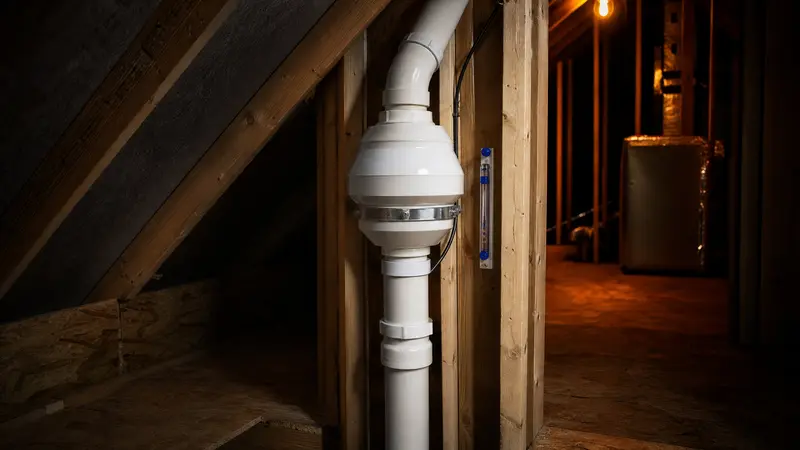
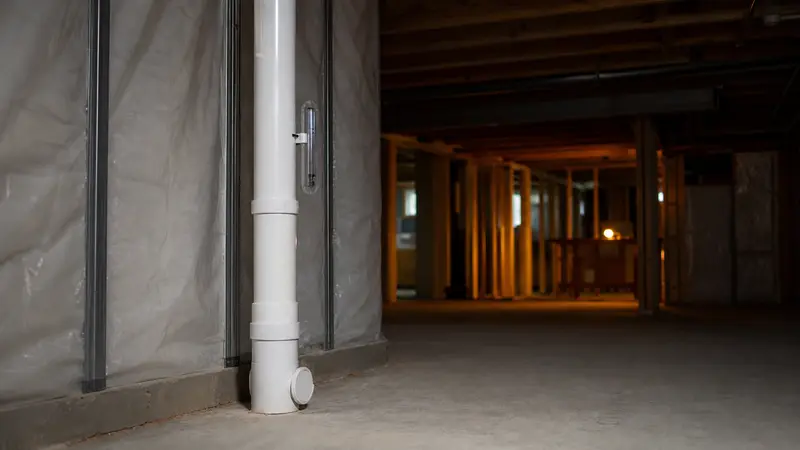
Not by itself. Many new homes have a passive radon system: gravel or a mat under the slab, plastic sheeting, sealing and a vent pipe through the roof. Without a fan, that pipe relies on the stack effect and wind to draw soil gas out.
Passive systems help in some homes and do little in others. The only way to know is to test. If the test reads 4.0 pCi/L or higher, a fan can usually be added to the existing pipe quickly, which turns it into an active system.
When to test a new home
Test after the home is finished and you are living in it, with normal heating or cooling running. Testing during construction does not give a useful result, because open doors, unfinished walls and missing HVAC change how air moves.
A few tips:
- Short-term first. A professional short-term test (at least 48 hours under closed-house conditions) gives you a quick read.
- Long-term for the full picture. A test of 90 days or more shows your year-round average.
- Test in the lowest lived-in level. That is usually the basement if you use it, or the first floor.
- Retest after changes. Finishing the basement, adding a fan or changing HVAC can shift radon levels.
EPA's A Citizen's Guide to Radon covers testing basics and what the numbers mean.
What your result means
| Result | What EPA says | What to do |
|---|---|---|
| 4.0 pCi/L or higher | Fix the home | Activate the passive system or install a full system |
| 2 to 4 pCi/L | Consider fixing | Weigh a fan, and retest seasonally |
| Below 2 pCi/L | Lower risk | Retest every few years and after major changes |
EPA estimates radon causes about 21,000 lung cancer deaths a year in the U.S. There are no immediate symptoms, which is why testing matters.
Buying a new home from a builder
If you are under contract on a new build, you have a chance to get radon settled before closing. Before you sign, ask whether the home will have radon-resistant features, where the vent pipe will run, whether there is an outlet in the attic and who pays to add a fan if the test is high. Our list of questions to ask your builder about radon covers the details.
Get answers in writing. Pennsylvania's seller disclosure rules cover known radon information, but some new-construction sales are exempt from the form, so ask directly.
New homes in York County
York County is in EPA Radon Zone 1, the highest radon potential category. New subdivisions across the county sit on the same radon-producing soil and rock as older neighborhoods. A new house here is not exempt.
Pennsylvania's building code does not require radon-resistant construction statewide, so some new homes in York County have a passive pipe and some do not. Either way, test after move-in. If you need a fix, Pennsylvania requires that it be done by a PA DEP certified mitigator.
Key takeaways
- New homes can have high radon. It comes from the ground, not the house's age.
- Tight construction and exhaust fans can make it worse.
- A passive radon pipe helps some homes but does not guarantee low levels.
- Test after move-in under normal living conditions.
- If the result is 4.0 pCi/L or higher, a fan can usually be added to the existing pipe.
Frequently Asked Questions
How soon after moving in should I test?
Once the home is finished and your heating or cooling is running normally. Many people test within the first few weeks.
My builder tested before closing. Do I need to test again?
It is a good idea to retest once you are living in the home, and again after major changes like finishing the basement.
Is it expensive to activate a passive system?
It is usually much less work than a full retrofit, since the pipe is already in place. Your quote depends on the fan, wiring and access.
Get your new home tested or activated
We test new homes and activate passive systems across York. Call (717) 356-3035 any time for a same-day callback and a free written quote.