
On this page
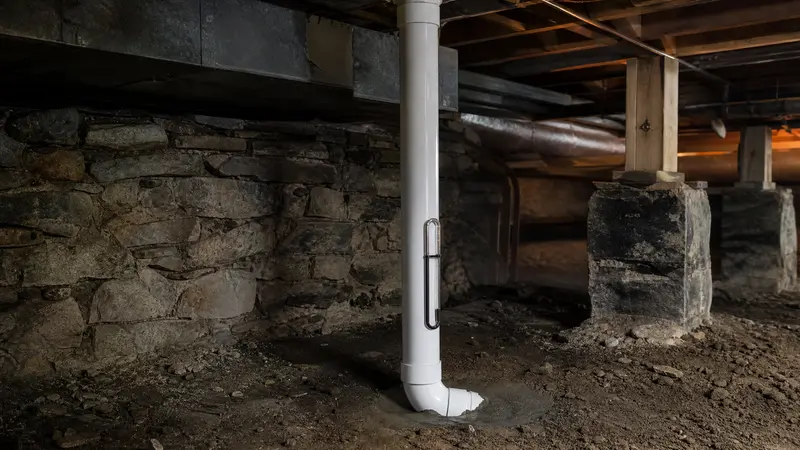
A dirt floor basement lets radon rise straight from the soil into your home. There are two main fixes, both common in radon work on older York basements: cover the soil with a heavy, sealed plastic membrane and put suction under it, or pour a concrete slab with suction under the slab. Partial dirt areas get a membrane sealed to the existing concrete floor.
Why dirt floors are a radon problem
Radon is a radioactive gas that forms in soil and rock as uranium breaks down. In most homes, a concrete slab sits between the soil and the room. Gas still finds cracks and gaps, but the slab slows it down.
A dirt floor has no barrier at all. The whole floor area is open soil, and in winter the stack effect pulls air from the basement up through the house. That lowers basement pressure and draws soil gas up through the dirt.
Dirt floors also bring moisture. Damp soil releases water vapor into the basement, which can lead to musty smells, mold on stored items and damp floor framing. A fix for radon can help with that too.
Option 1: Membrane with sub-membrane suction
The most common fix is sub-membrane depressurization (SMD). It works like this:
- Prepare the floor. Rocks, debris and sharp objects are cleared so they do not puncture the plastic.
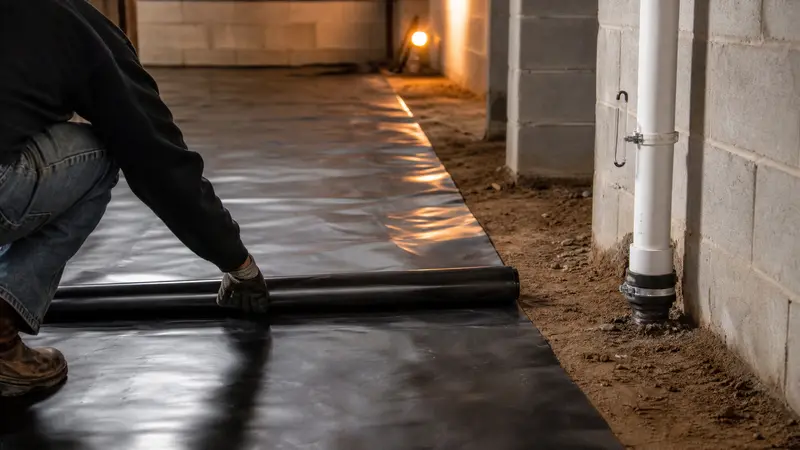
- Lay a heavy membrane. A thick, reinforced plastic sheet covers all exposed soil. Seams overlap and are sealed with tape or sealant.
- Seal the edges. The membrane is sealed to the foundation walls, around posts and piers, and to any concrete it meets.
- Add suction. A pipe is placed under the membrane, often with a short run of perforated pipe or a fitting that keeps an air space. It connects to a fan that vents above the roof.
- Test. A clearance test runs at least 24 hours after the fan starts and within 30 days.
The fan pulls soil gas from under the plastic, so the membrane gets sucked down slightly against the soil. That is how you can tell it is working.
Pros: Lower cost than concrete, fast to install, and the area stays usable for storage if you walk on it carefully.
Cons: Plastic can be torn by heavy foot traffic, stored items or pets. Tears have to be patched to keep the system working.
Option 2: Pour a concrete slab
The other route is to pour a new concrete floor over the soil. For radon, the best way to do this is to lay gravel and a plastic sheet first, set a suction pipe in the gravel, then pour. The fan then pulls from the gravel layer, the same way a standard sub-slab system works.
Pros: A durable, usable floor. Easier to clean. Good airflow under the slab when gravel is used.
Cons: Higher cost and more work. Low ceilings in old basements may not allow the added height. Access for concrete can be hard in rowhomes and tight lots.
A slab poured without a suction pipe and without a fan may lower radon somewhat, but it is not a radon system. Slabs crack, and gas finds the gap at the walls.
Partial dirt floors
Many older York basements are mostly concrete with one or more dirt areas. Common spots include:
- An old coal bin or coal room.
- A root cellar or storage nook.
- Space under the front porch or a back addition.
- A strip along one wall where the floor was never finished.
These areas are often the biggest radon source in the basement. A slab system can work fine on the concrete part while gas pours in through the dirt. The fix is to cover the dirt with a membrane, seal it to the edge of the slab, and tie it into the same fan. Often one fan can serve both the slab suction point and the membrane suction point.
If the dirt area sits behind a wall or under an addition, it may be a separate crawl space. That gets the same membrane-and-suction treatment.
Membrane vs. slab: quick comparison
| Factor | Sealed membrane + suction | New slab + suction |
|---|---|---|
| Cost | Lower | Higher |
| Install time | Usually one day | Several days, plus cure time |
| Durability | Can tear; needs care | Long-lasting |
| Floor use | Light storage | Full use |
| Moisture help | Good | Good |
Dirt floors in York homes
Dirt floors and partial dirt areas show up most often in York's older city housing, including rowhomes and twins built before poured floors were standard. Rowhomes add their own wrinkles, like tight access and shared walls. Our guide to radon mitigation in York rowhomes and twins covers those.
York County is in EPA Radon Zone 1. If your basement has any exposed soil, testing is the first step. The EPA's radon page explains how to test and what the results mean.
Key takeaways
- A dirt floor gives radon a direct, wide-open path into the house.
- A sealed membrane with suction under it is the most common fix.
- A new slab works too, but should include gravel and a suction pipe.
- Partial dirt areas such as coal bins are often the main source and must be covered.
- One fan can often serve both a slab and a membrane area.
Frequently Asked Questions
Can I just put down plastic sheeting myself?
Loose plastic helps a little with moisture, but it is not a radon fix. Without sealed seams and edges and a fan under it, gas still escapes around it.
How thick should the membrane be?
Radon standards set a minimum thickness, and many installers use heavier reinforced liners that hold up better to foot traffic. Your quote should name the material.
Can I store things on the membrane?
Yes, with care. Set boxes on boards or a pallet so sharp edges do not puncture the plastic, and patch any tear right away.
Get your dirt floor covered right
A dirt or partial dirt floor is one of the most common things we fix in older homes. Call (717) 356-3035 any time for a same-day callback and a free written quote.